

Written by: Jonathan Herman & Andrea Berloff
Starring: O’Shea Jackson Jr., Corey Hawkins, Jason Mitchell, Paul Giamatti, Marlon Yates Jr.
Rating: [4/5]
Crafting biopics with the approval of the subjects focused on presents a resourceful level of access to their story but also with the drawback of a level of honesty hidden behind the more desirable aspects of the story even if the undesirable remains formative to the whole story. Something everyone must reckon with when watching these films as they tell a glossy tale of these figures as seen in Straight Outta Compton, but at least in the case of this film it seeks to present a larger image going beyond the indiscretions of the group making for quite a phenomenal film.
Bustling with talent but stuck in their respective holes, Andrew Young (Corey Hawkins) convinces Eric Wright (Jaoson Mitchell) to perform a song the former could not sell off to a group, which instantly makes them an overnight success. This gives them the capital and idea to craft their rap group N.W.A, with three others to reach the pinnacle of musical notoriety.
A plethora of emotions flow through in watching Straight Outta Compton, a film following the formulas we all know about musical biopics depicting the rise, fall, and rise again of flawed individuals with so much talent. The way to stand out in this genre comes from bringing something new to the table on a filmmaking level, which we get in this film and it comes right at the audience with the propulsive energy because of the situations these men found themselves in their journey towards the top. Not only were these men creating controversial music of the time, but also found themself embroiled in a turning point in the relationship between African Americans and the police.
With protests against police brutality around the horrific circumstance of Rodney King presents one of the major themes this film has to offer. One where it informs the music made and what guides these characters through their journey as artists. They experience the brunt end of the stick in moments because of it, which makes for several aggravating scenes involving the police and the way they treat these men. This unrest sits at the very core of this music and very much defines them in the way they approach their careers.
Above all, if anything N.W.A represents a group of defiance from the powers that be as seen through their journey. Starting out in humble places in their lives they refused to forsake what they believe even in moments where it may have been beneficial, which certainly deserves some respect. Their music and what they represented brought much scrutiny upon them making them a target of law enforcement. Something they knew quite well and remain unafraid of the consequences because they use their music as their weapon and voice when these individuals try to drown them out and evidently it works. The scene where they receive the warning from the police not to sing their antagonistic song, “Fuck Tha Police” and then do it anyway makes for quite the enthralling scene showing exactly what these men represented.
Bringing forth the music of this group demonstrates the work that went into creating the great songs we know. It demonstrates all of the pieces coming together, which happens quite often in musical biopics. You see who put in the work and then who receives all of the credit which occurs with Eric and O’Shea Jackson (O’Shea Jackson Jr.). Again, the perspective into this story could have some skew to those who walk amongst us today getting more input but it definitely enlightens on their entire process. It allows each of these characters to shine in their own way and none stood out more than O’Shea Jackson Jr. portraying his very own father.
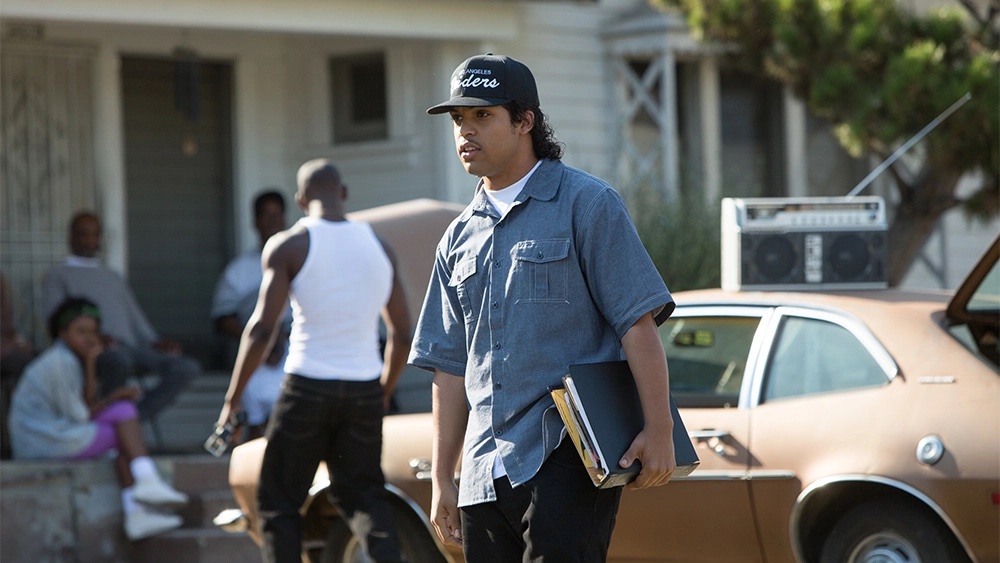
Having grown up mostly in the 2000s, knowing Ice Cube mostly for his roles in comedic family movies painted a picture of someone known for being tough but never giving me the material to look back and see why. This feature thus became a revelation in displaying his rise and just how fierce the man could be with the bars he delivered. The fact Ice Cube’s very own son portrays him as his younger self must have been quite the emotional experience and it certainly helps when his son absolutely knocked it out of the park in his performance. Seriously, the bars O’Shea Jackson Jr. drops through the course of this movie demonstrate just how impactful Ice Cube’s contribution to the group was and how he delivered such fierce lines to his adversaries. The diss track he drops on Eric really sums it all up and serves as one of the highlights of the feature.
Completely engrossing and effective, Straight Outta Compton may dance around some incredibly problematic aspects of the men in this story, but it delivers quite the enthralling viewing experience. Something with so much energy and anger pointed directly towards a system these men refused to make them shut their mouths. Equally inspirational as it is aggravating, this feature takes us on quite the journey and puts us right in with this musical group as they refuse to let go of who they are even with all of the pressure mounting around them. The music, while already in circulation for decades, continues to have power, and having them repurposed in this feature makes it land even harder.

 Films with Josh
