
.jpeg)
Written by: Anthony Veiller, Victor Trivas, Decla Dunning
Starring: Edward G. Robinson, Loretta Young, Orson Welles, Philip Merivale, Richard Long
Rating: [4/5]
The concept of love being blind centers on the idea of individuals ignoring the red flags of someone they care for because of the ease of simply ignoring and wishing it away. This occurs even when the evidence to the contrary becomes clear as day as displayed in The Stranger. Definitely delivering an extreme example of this quandary and one presenting a gripping and entertaining feature film.
Following the finale of World War II, Mr. Wilson (Edward G. Robinson) seeks to find a Nazi fugitive, Franz Kindler (Orson Welles), who has tried to blend in here in the United States. Upon his search, he ends up in Connecticut where his suspicions rise of Kindler passing as Professor Charles Rankin, although Wilson cannot prove the identity.
Hunting down Nazis following World War II served as one the nobler jobs out there because it comes in service of accountability and assuring those who directly participated in one of the most horrific genocides of history suffer the consequences of their actions. As one can expect, once they could no longer have refuge in their own nation, like roaches, these individuals ran to different countries like Argentina, and in this feature in the small state of Connecticut in the United States. Kindler certainly has some audacity in trying to get away with hiding away in the very nation bringing an end to what he accomplished. With his presence unknown to others and Mr. Wilson, we become privy to the truth but watch as others begin to see through his façade as well.
In this instance, as audience members, we know more than the other characters and watch the ways Kindler slips up in revealing his identity. As the feature displays, the man not only participated in the horrendous action of the Holocaust but also played a direct hand in crafting the concentration camps that killed millions of Jews. Someone as terrible as this man proves it in this feature with the ruthlessness he employs to avoid exposure that makes him do some unforgivable acts for those who care for humans but also canines. The man certainly will not endear himself to anyone other than Nazi sympathizers with his actions here but it serves as a survival tactic for him because he knows what fate awaits him if he ever gets exposed and caught.
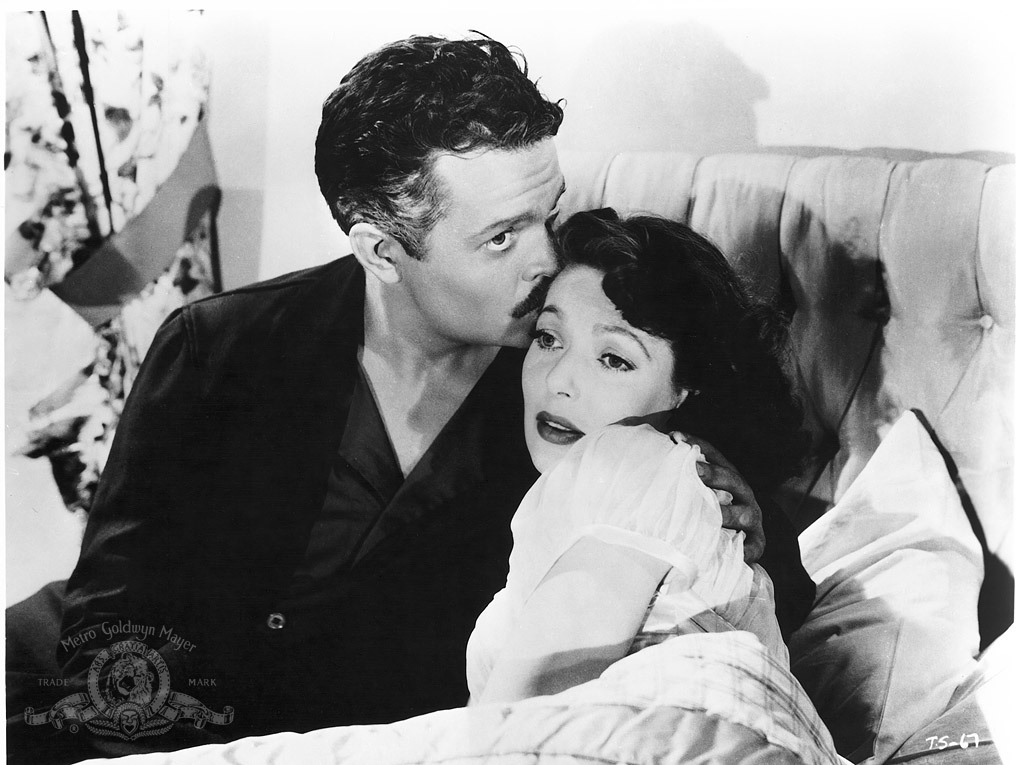
This puts his wife, who knows him as Charles Rankin in such a terrible position. Trying to put oneself in her shoes where she falls in love with a man and commits to spend the rest of her days with him only to find out the man served as one of the worst perpetrators of the Holocaust. This fact proves difficult to believe at first when presented with the evidence and rightfully so considering it’s such a terrifying thing to learn about someone she thought she knew, but this shattering of perception helps push the feature along and ultimately serves as the last straw in ratcheting up the pressure and tension of this film. With everything beginning to crumble around him Mary remains the only safety he has and once she learns about his heinous previous deed, it well and truly sets everything off.
Starring and directing in this feature, Orson Welles not only pieces together something so well-crafted but also puts himself in the role of the villain. Something stars certainly did not try to do too often because of the stigma it creates around their stardom. No one wants to necessarily be the heavy of the story, but he knew how well he could portray this menacing figure because of the natural affability he presents as an actor making it quite difficult to believe the character he portrays could possibly commit such horrific crimes. A bold move by Welles and one that certainly paid dividends toward the quality of the feature overall.
In addition to Welles, Loretta Young deserves so much credit for her portrayal of Mary in this unfortunate circumstance. Young does so well in displaying the conflicting feelings of her character in the process of denying reality for the sake of maintaining the bubble of the life she has created with a loving man. When the reveal becomes far too apparent to ignore, those emotional moments she needs to deliver well and truly make quite the impact because of the empathy she builds for her character that cannot be ignored. Starring opposite of Welles sees her measure right up to him and deliver an equally powerful performance.
Quite enjoyable as a feature in the tension it builds and how it navigates its stories, The Stranger takes us along for the ride of a manhunt to track down someone trying to evade accountability by all means. We see all of his actions and can only hope Mr. Wilson and Mary find out before they also serve as casualties of Kindler’s insistence on keeping everything about his identity secret. Everything culminates in a thrilling final sequence showing the desperation of all parties involved further demonstrating the directing acumen of Welles.

 Films with Josh
.jpeg)