

Written by: Edward Yang
Starring: Wu Nien-jen, Elaine Jin, Issey Ogata, Kelly Lee, Jonathan Chang, Hsi-Sheng Chen
Rating: [4.5/5]
The lived experiences of individuals may carry some similarities, but much like our fingerprints, they contain a distinct uniqueness that makes each journey refreshing to experience. It allows the idea of experiencing universal moments differently because of the differences we inhabit from the person right next to us, which Yi Yi captures with a certain zeal and infectious spirit. Making for an unforgettable film, this familial drama splits into different tangents but does not forget to stick the landing when bringing it all together.
Living in Taipei, NJ (Wu Nien-jen) runs a household with his wife, Min-Min (Elaine Jin), daughter Ting-Ting (Kelly Lee), and son Yang-Yang (Jonathan Chang). Following the wedding of his brother-in-law, he runs into an ex-girlfriend, Sherry (Su-Yun Ko), who he continually runs into at the same time as the other members of the family go through their own life encounters.
Distilling what Yi Yi captures in a narrative could lead someone to write a novel because of the beautiful richness and layers involved with telling a story such as this one. Operating with many threads to follow, it manages to keep a level head on each of them, and most importantly, deliver on each of them not necessarily through this euphoric realization they come to but rather how it relates to life as a whole. Generally, the circumstances each of the characters within this family unit experiences have the potential for heightened drama, Edward Yang opts for a more matter-of-fact approach about the impacts and the lingering emotional issue transpiring internally as opposed to the combustible external. It evokes this resoluteness in the film not wanting to necessarily provide answers but still deliver something to ponder as we walk away from each of these circumstances play out.
One thing each of these family members have in common is this sense of melancholy surrounding their current living circumstances. It does not necessarily relate to their family members but it certainly does play a part. NJ, in particular, contends with the what-ifs his life has before him regarding his ex-girlfriend. A thought that feels inappropriate to explore considering the man has a wife and two children, but where NJ finds himself at this point in life has him trying to seek answers from somewhere. The elements of his life that bring surety have him dissatisfied meaning his dreaming of what could have happened with an ex provides this sensation that he so desperately craves. Following him and his journey makes for many enriching observations of how men such as him view the women around him, especially when contrasting it with his wife and everything that comes with it.
While we spend the most time with NJ and the particular journey he goes on, the other family members each get their own resolute story to follow unearthing some wonderful kernels of truth. One, however, that I wish could have received more was Yang-Yang and the way he relates his half-truths and the way we humans can only see one half. How it relates to the photographs carries such a power and Jonathan Chang does a splendid job as a child actor in delivering some of Edward Yang’s finest dialogue. The way the deepest and most hard-hitting scenes come from a child trying to piece together elements of life through his personal perspective makes it all the more devastatingly impactful. I cannot question the effectiveness of how Yang-Yang gets utilized in the film when viewing the overall quality of this film, but it speaks highly of Yang-Yang as a character and how much he intrigued and captivated with the limited screen time.
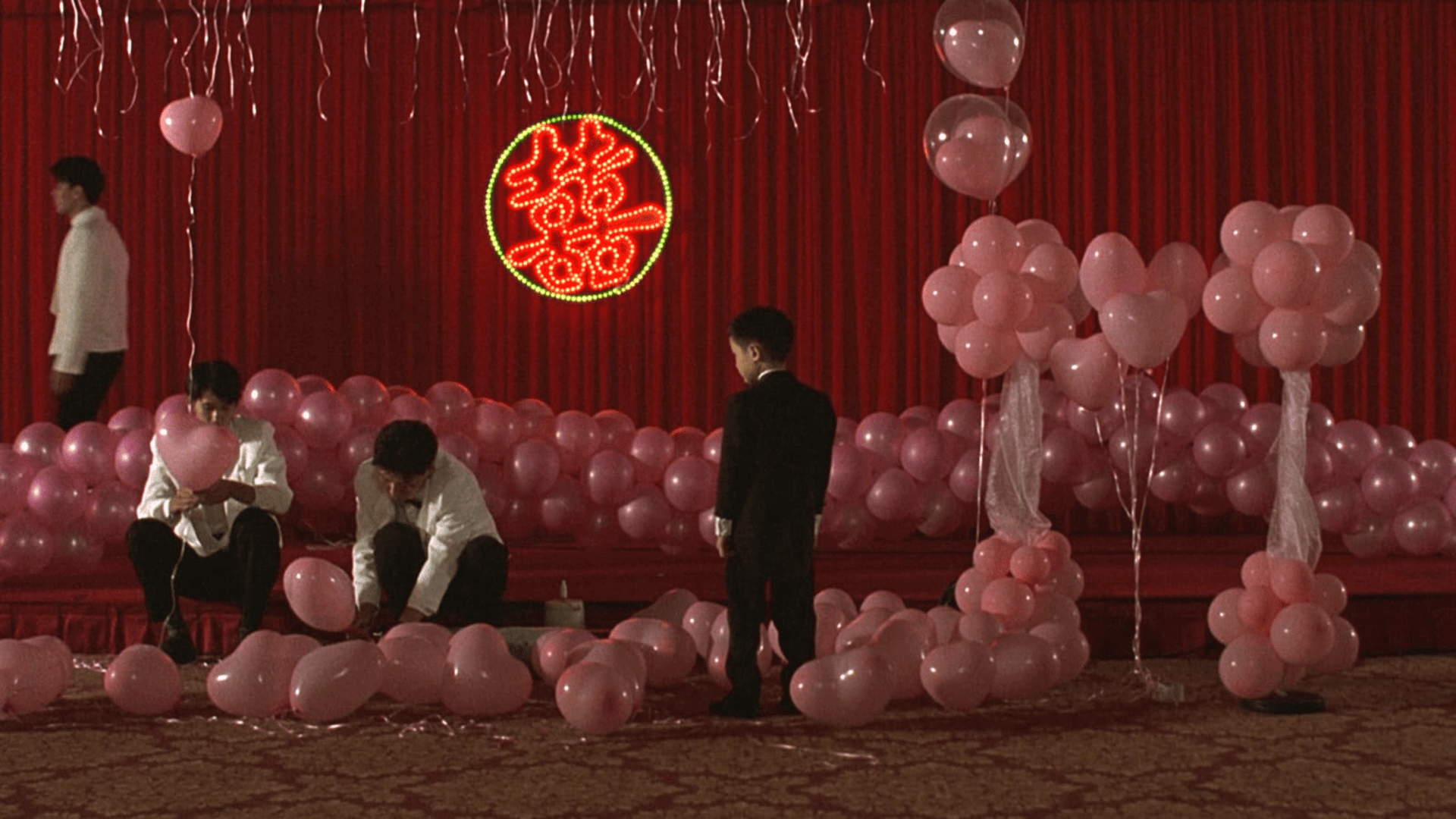
On top of the emotional heft he delivers, Yang-Yang stands in for some of the most stunning and iconic shots this feature has to offer. From the wedding scene to the image of him taking pictures, he stands as what most individuals will walk away from this film thinking about and it certainly makes a discernible difference. Everything with the wedding scene displays this film at its visual apex allowing for this jaw-dropping red background having these characters pop against it. We get some brilliant uses of color here to help convey the emotion of what transpires internally for these characters. It further intensifies it all, showing Edward Yang’s endless talent behind the camera.
With that said, the true majesty on display by Edward Yang comes from his screenplay. The way he manages to navigate these different storylines, which each carries significantly resonant character work displays his greatness. None of them feel shortchanged and all have such a beautiful impact. With the juggling act, he puts together some sensational pieces of dialogue, especially with Yang-Yang. He allows the empty spaces to fill in the rest of what the film wants to communicate as these characters deal with this particular aspect of life in such an effective manner and it all starts in the way Edward Yang brings it all together.
Watching Yi Yi will deliver quite the experience that will have a different impact based on where one is at in life. With the events each of these characters experience in the film, one could certainly relate to them allowing subsequent viewings to bring a unique perspective. Whether someone finds themselves in a place where they think of the what-ifs or the pain of losing a loved one or trying to find love, each of the family members of this nuclear family represents something distinct about the human experience. As we navigate between them all, we get such a fulfilling and incredibly well-crafted tale and one that sticks with you far after the story concludes.

 Films with Josh
