

Written by: Ryūzō Kikushima, Akira Kurosawa, Hideo Oguni
Starring: Toshiro Mifune, Tatsuya Nakadai, Yoko Tsukasa, Isuzu Yamada, Daisuke Katō
Rating: [5/5]
When nothing can get done effectively, an outside point of view can provide the necessary fresh perspective to reach real solutions. An idea that many businesses voluntarily bring on consultants, or in the manner we witness in Yojimbo. Hugely influential and weirdly hilarious, this film tells one of the greatest samurai stories ever put to screen and does so in a thoroughly entertaining manner.
Wandering through the country a rōnin (Toshiro Mifune) happens upon a random town that has become entrenched in a deadly war between two warring factions. As an outsider, he decides to lend his sword and abilities to one side where he then sees the opportunity to play both against each other and reach a mutually assured destruction with him as the mastermind in the middle of it leaving the rest of the townsfolk as the beneficiaries of his intervention.
It does not take long to find what films have felt the influence of Yojimbo and the way it navigates its story of a nameless figure coming in and making some real change. Flowing into different genres, this idea stands alone through such a fun character we follow in this film and the way it pushes through its narrative displays its unflinching brilliance. Not only does it provide a commentary on the ills of gang rule but the way Sanjuro continuously fools them makes for such a surprisingly comedic ride.
Everything about this rōnin comes shrouded in mystery to the degree that we never truly learn his name. He simply chooses Sanjuro as a placeholder for others to call him when the full name he selected essentially means “thirty-year-old Mulberry field.” Even with the little characterization we do not receive from him simply by not having his name, we get to navigate his morality and how he navigates this hairy situation. He can certainly elect to permanently sell his services as a samurai to one side or the other for a bountiful profit. Instead, the more perilous decision is to play both sides where he makes an enemy of both sides inadvertently instead of merely having one gunning for him at a time. His decisions initially make no sense and just as we try to figure out his motivations we learn more about him as a person.
In the town itself, we have two warring bosses essentially leading groups that leave the rest of the townsfolk hostage with the violence they inflict. The town essentially appears like a ghost town in moments when Sanjuro wanders on in where you can sense the general sense of fear emanating from everyone the rōnin interacts with, which makes his intervention all the more impressive. With the limited geography of the film, it feels so restrictive and creates this gradual constriction on these characters and the eventual battle that will continue to occur between them adding to the drama of this entire affair.
With Sanjuro playing both sides, deception proves as the name of the game and it naturally creates this tension in all of the interactions he has with the warring gangs. The eventual reveal of him two-timing them sits right at the cusp on multiple occasions making it imperative he remains careful in what he says and how he decides to continue to gaslight them into believing what the opposing side does to further antagonize the situation. As skilled as Sanjuro may be with his blade, he’s only one man, and getting found out by one side could shorten his lifespan. With each interaction, he steps into a hornet’s nest and the way he manages to navigate it fuels much of the fun this film provides on top of the comedy of the gullibility these gangs display in their trust of him. Therefore, we have this mix of tension, comedy, and action all stitched together in a thoroughly engaging manner to piece together what Yojimbo creates as a narrative. It gets each of these aspects right as it nails down exactly what it seeks to accomplish.
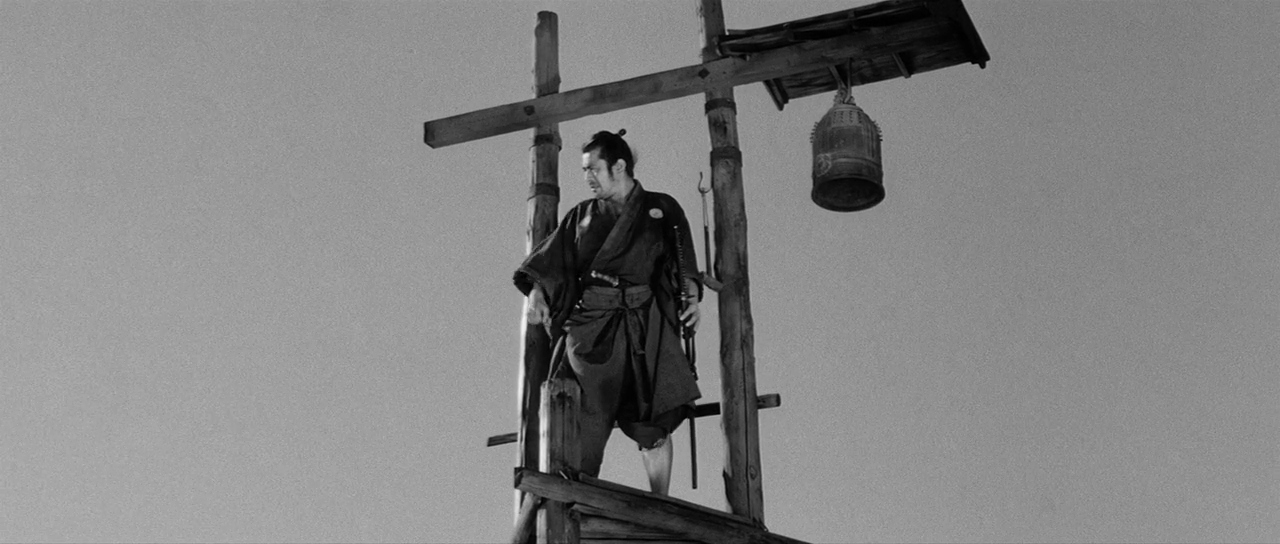
Of course, this could only be pulled off by someone as incredibly skilled as an actor as Toshiro Mifune. Stepping in without the dignity of some warrior with some high esteem but rather someone who’s simply looking for food and a bed each night, Mifune unsurprisingly does exceptionally well in capturing the aura and mystery of Sanjuro. Working with no name but certainly not missing a personality, following him through the course of this film displays the legendary actor working in top form. He does not have the loud outbursts he does in Seven Samurai but rather this calm demeanor where it looks like he’s not sweating this particularly precarious circumstance he’s put himself in. More cool, calm, and collected with this approach, and Mifune fits right into it like a glove in evoking this sense of confidence but also shagginess with the lack of formality of this character.
Stating Kurosawa made a great film feels like the equivalence of mentioning water is wet, but he creates something quite special here in Yojimbo. A startlingly fantastic samurai feature that has its fingerprints on many films that sought to emulate its impeccable success. In this feature we get this mysterious character suddenly thrust into a circumstance he feels he must intervene and the way he goes about it displays a brilliance and a comedy that I did not expect when first stepping into the viewing experience. The master filmmaker highlights this circumstance in such an impeccable manner that lives up to the high standards he has made for himself. We get plenty of deception but all at the expense of some terrible individuals who enjoy the power they have and the way they can inflict it upon others. Sanjuro quickly becomes one of the great characters in film history by the way he saunters around this town as someone who will do the right thing, but at the end of the day, the man just wants a soft bed to sleep on and some nourishment.

 Films with Josh
