

Written by: Takashi Yamazaki
Starring: Ryunosuke Kamiki, Minami Hamabe, Yuki Yamada, Munetaka Aoki, Hidetaka Yoshioka
Rating: [4.5/5]
Stories that make their mark overseas and then find their way to America to have their own versions made have typically not fared well for the material. Something gets lost in translation or sensibilities do not match, thus making for subpar material. American made Godzilla films have represented this very notion for me, where many of them fail to deliver anything worthwhile, which makes me question the true value of what this monster represents. However, going back to the source such as Godzilla Minus One displays the true breadth and potential that can happen with this monster that made everything click in a resounding manner.
Landing in Odo Island saying his plane needs repairs, kamikaze pilot Kōichi Shikishima (Ryunosuke Kamiki) and the rest of the Japanese soldiers there confront a large and vicious Godzilla. When asked to get on his plane and fire at the monster, he panics, gets knocked out and when he awakens sees that nearly all the men on this island were killed by this attack. Returning home filled with shame, he sees what remains after the destruction of the war.
The true origins of Godzilla and what the monster represents has never been a secret, which came as no surprise that films made through an American lens would never capture the essence of the feat this creature can imbue by its mere presence. Americans, after all, created this fear with their use of nuclear weapons, which made it clear seeing a Godzilla film originating in Japan would deliver something wholly different and this one certainly did. Instead of serving as this spectacle for us to gawk at, this creature serves as a source of fear and a representation of loss that instantly ups the emotional stakes as well as delivering some incredible action as well.
One of the gripes I typically have with the American Godzilla films came from the lack of compelling human characters, where I sought more time with the giant lizard instead. Godzilla Minus One delivers on all fronts, where it certainly gave us some incredible scenes of this monster doing some damage, but seeing Kōichi’s story play out nearly brought me to tears in moments as he and others deal with survivor’s guilt following World War II. Seeing the aftermath of everything that happened, whether inflicted by Godzilla or not, left many in a place of conflict where they felt guilty for surviving what happened when so many others died. It left them to pick up the remaining remnants of their past and try to forge something new. We see this play out with Kōichi seeking to care for Noriko (Minami Hamabe) and the orphaned Akiko (Sae Nagatani). All three have lost everyone else and decide to create this makeshift family, which gives us the emotional grounding for this story and something worth fighting for.
This particular character arc for Kōichi also digs into his cowardice where he failed in his duties as a kamikaze pilot during the war because of it and taking on this monster who he could have put an end to before serves as his mission. Given not one he may survive in the end but this resoluteness he builds looks night and day compared to the Kōichi we first encounter in the opening scene, which makes the moments without the giant lizard on the frame resonant because we care so much about this guy and the family he has now crafted and cares for.
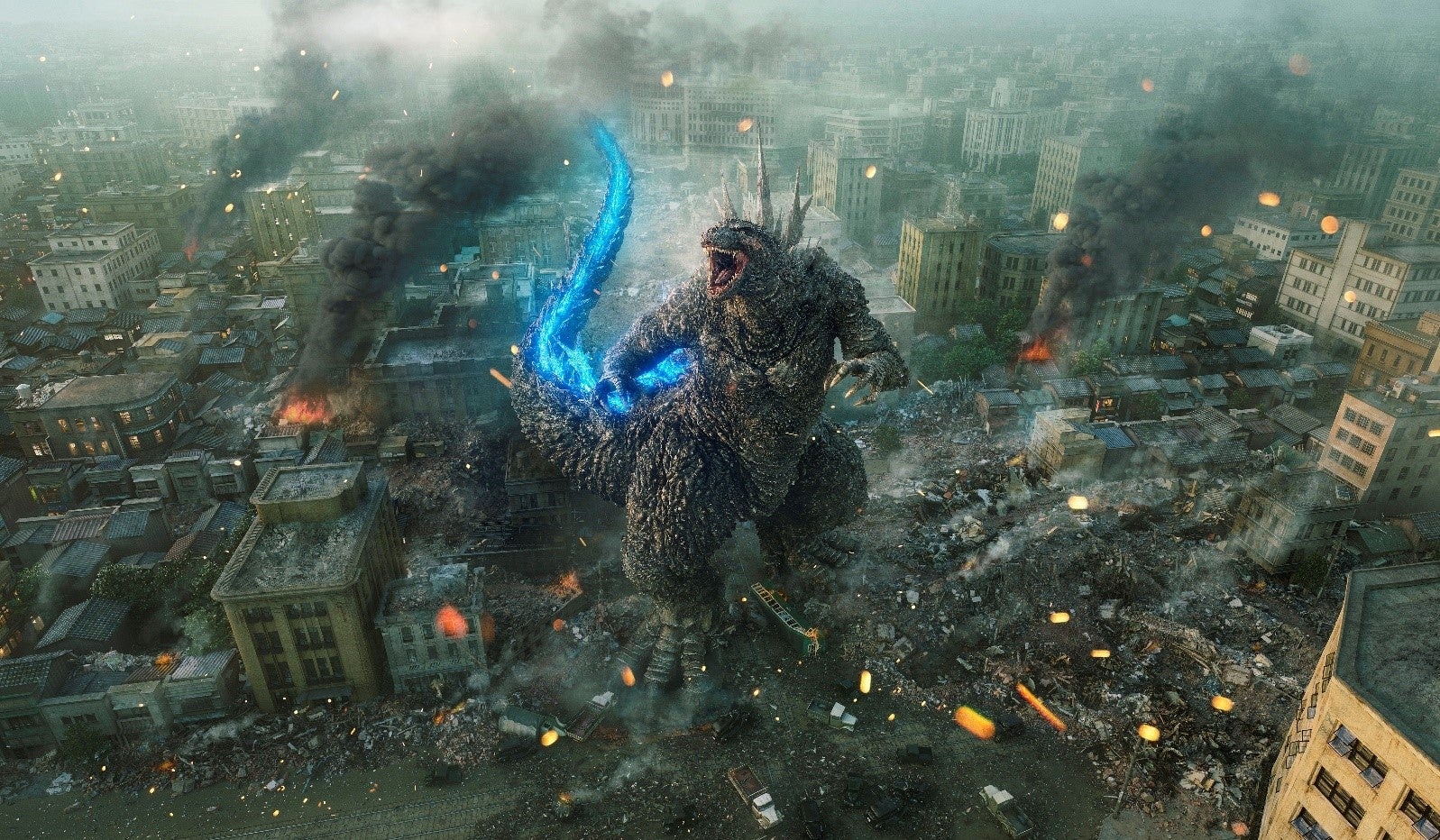
Even with the great character beats, the main attraction of any Godzilla film, the lizard himself did not disappoint and, in fact, delivered in spades to display the utter destruction this creature enacts by a simple swing of its tail. This iteration of the creature has an epic looking design, with its spine having these jagged edges that make it look even fiercer. The way it regenerates after all the attempts in taking it down creates this sense of hopelessness in every attempt trying to take it down, especially with the damage it causes and a lack of a clear goal they can all gather from its actions. Everything about this visual representation of Godzilla exhibits exactly what makes this creature such a historically resonant character in film and the awe and fear we should feel about it makes itself evident here, which cannot be said about the American made versions.
Ultimately, again, what makes this film stand apart from the rest I have seen, granted there are plenty I have not, comes from the beautiful human story at the center. Yes, we have this beautiful character arc for Kōichi but we also see this gathering of humanity with these citizens who all come together to put their minds and hearts in unison in order to devise a plan to kill this creature. The government will certainly not do its part, meaning it gets left to the citizens to figure this all out themselves. Those moments of gatherings where they argue and find solutions to take out this common enemy brings this life-affirming quality of this film that continues to ratchet up the emotions at hand. This film has that ultimate balance where we spend enough time with these characters to truly care for them, and get Godzilla in fine enough doses where the creature has a presence but does not overstay its welcome. Enough cannot be said about the incredible work by Takashi Yamazaki in crafting one of if not the greatest monster film I have ever seen, especially any including Godzilla.

 Films with Josh
