

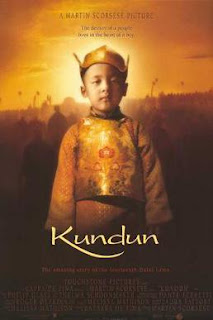
Written by: Melissa Mathison
Starring: Tenzin Thuthob Tsarong, Gyurme Tethong, Tulku Jamyang Kunga Tenzin
Rating: [3.5/5]
Throughout history, we have seen instances where young people step into massive positions of power through birthright, such as in monarchies. When not at an age where they can say the full alphabet, they carry the hopes and reality of millions upon their shoulders. A heavy burden for anyone to follow but placing it on a child becomes a whole different ball game. Kundun explores this journey through the choosing of a new Dalai Lama where he exists not only as a religious leader, but because of circumstances, a political one as well.
Passing the test laid out before him at the age of two, a new Dalai Lama (Tenzin Thuthob Tsarong) gets chosen following the passing of the previous one. Trying to learn the ropes and lead his people properly, he must now contend with the Communist party of China led by Chairman Mao Zedong (Robert Lin), who not only wants to take over Tibet but eradicate all religion within it.
As mentioned previously, Kundun centers on a religious leader and the duties that come with it but because of circumstances out of his control, he needs to step in to deal with the difficult political ramifications of China’s aggression. A decision well beyond what should be laid out before a young man by the time the film gets to this sequence. It creates a daunting task and the weight of this gets felt in each passing scene with the Dalai Lama and ultimately leads to the success of the film as a whole. For us to get fully engrossed in this story, we need to feel the behemoth of a job this one individual has, especially when having to confront a regime that has no issue exterminating people for simply believing in a religion.
Stepping into this role, we can see all of the pomp and circumstance that comes with it. The average person has most likely heard of and maybe seen a picture of the Dalai Lama but they may, like myself, not fully grasp the importance he carries to the Buddhist religion and the country of Tibet as a whole. This feature undoubtedly makes that message clear and it makes it difficult to fully discuss this film without the elements that happened on the outside where Disney, the parent company of Miramax that produced this film had to wipe this movie from existence because of China’s disapproval of this feature. Like many other films that have perturbed governments or hateful groups of people, it must mean the film really does something right, and when watching this film you can see why. It portrays this deep spirituality imbued into one individual and the Chinese regime’s efforts to squash this dissent and the leader at the top such as the Dalai Lama appears as nothing but cruel. This comes loud and clear within the film and helps build up the legend of it.
Falling right in line with films tackling faith, the fact Martin Scorsese directed this feature continues to display why he will forever remain one of the greatest filmmakers of all time. He has made several films that delve deep into Christian theology and struggle of faith his characters have but he expands beyond that to look at the Dalai Lama and how his role intersects with a nonviolent approach that will lead to the deaths and where he finds himself trying to reconcile it all within himself. Scorsese not only captures the beauty on the outside with these beautiful sceneries but also the internal anguish that comes with what this character needs to navigate. Truly the perfect director to take on a project like this other than someone from the particular background who has more direct experience with the religious implications but the way Scorsese marries it with the political brings a wholly intriguing perspective that allows this feature to maintain staying power.
Somehow a controversial movie by its mere existence, Kundun will probably forever stand as his most underseen film for reasons out of his control. Even so, he creates something powerful through the story of the Dalai Lama and this journey that started at the young age of two. Navigating this circumstance places such a weight and that gets felt through each stage for the Dalai Lama all the way until he makes the ultimate one in the end for what works best for him and his people.

 Films with Josh
