

Written by: The Wachowskis
Starring: Keanu Reeves, Laurence Fishburne, Carrie-Anne Moss, Hugo Weaving, Jada Pinkett Smith
Rating: [5/5]
Creating a sequel to one of the greatest films ever made certainly comes with a bevy of challenges, especially when building out a world as fascinating as the one crafted in The Matrix. A gargantuan task and one the Wachowskis met by not only further expanding the world of their colossal hit but also daring to defy expectations of what it means to fulfill a prophecy.
With news of a sentinel army drilling into Zion, Neo (Keanu Reeves) and the rest of the crew of the Nebuchadnezzar return to the last remaining human city, Zion, while awaiting word from the Oracle (Gloria Foster) on what must be done to end this war. As they get their task, the once-destroyed Agent Smith (Hugo Weaving) has returned with something different about him this time.
Leaving off the first film with Neo at full realization of his place as The One in this saga set the stage for what comes next. His full self-realization has brought a level of hope but now that meets the practicality of how they can fully utilize him to finally end this war against the machines that Morpheus (Laurence Fishburne) wholeheartedly believes. That requires meeting some new characters and programs, which this film has so much of its fun in introducing and playing with.
For the most part the first film introduced us to two major programs within the Matrix, the Oracle and the agents but in this feature we get many more and the role they play. They each have their purpose, but they do not all operate harmoniously as one would expect. The instructions of the Oracle lead the trio to the Merovingian (Lambert Wilson) and his motley crew. A pusher and navigator of information and they need someone quite important to him making for quite the perilous situation for them all. However, in the process we also meet his wife Persephone (Monica Bellucci), and Neil and Adrian Rayment as twins with intangibility when necessary. Fascinating elements to throw in and they apply into this circumstance, Neo, Morpheus, and Trinity (Carrie-Anne Moss) have to either battle or utilize to get to what they need for the next phase of the plan. It creates this intriguing divide between the agents and these older programs, who navigate the Matrix in their own way.
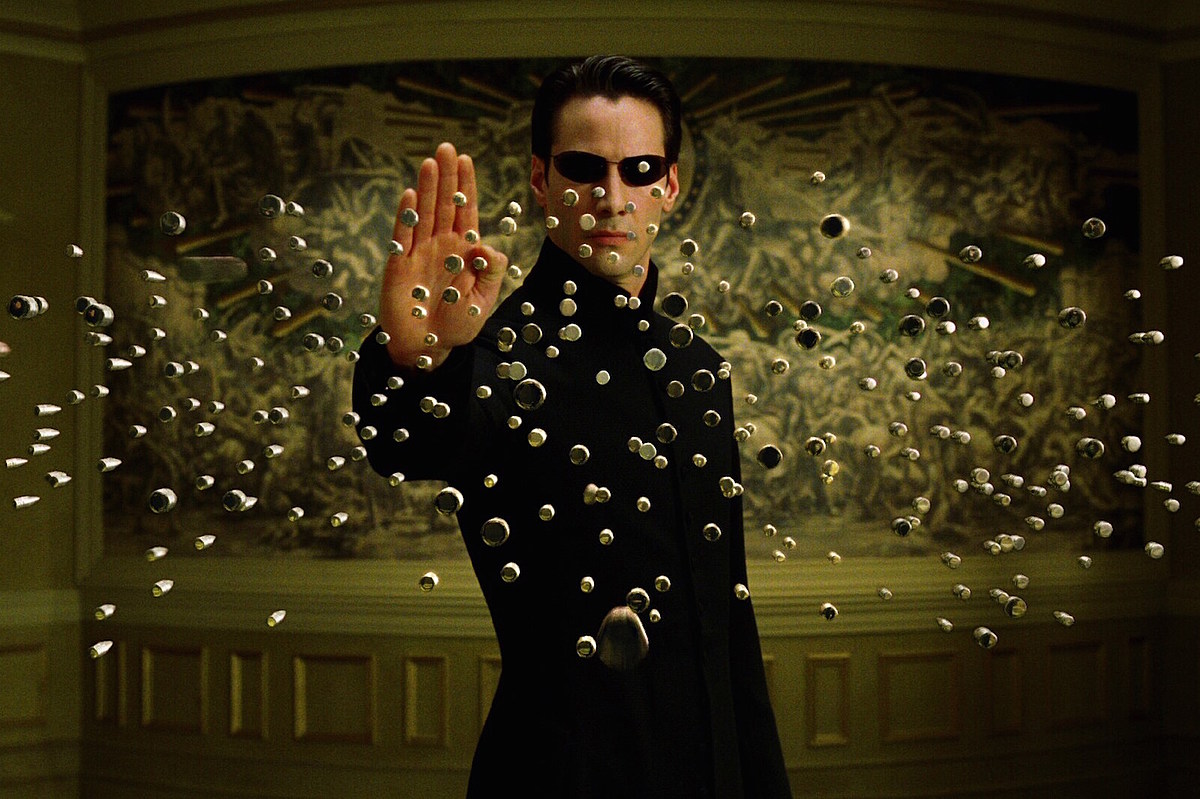
With Neo fully realizing his power, this film ran the risk of eliminating peril for this lead character, where fighting anyone at this point does not present a challenge. This displays itself quite clearly when facing off some agents in the beginning of the film where he takes on three of them at once and essentially utilizes them as sparring practice as opposed to a threat anyone would run away from if it were just one. However, that’s commonplace in many action films and most of them do not have the stellar fight choreography we see take place in this feature. Everything in the Chateau where Neo takes on a whole host of enemies was truly a chef’s kiss in displaying the power Neo has amassed and systematically can take out enemies. It also feels much more polished compared to the action in the previous film, even if losing some of the intensity of each blow.
Not only does the fight choreography rule, but also institutes one of the great car chase sequences ever put to film. All underscored by the awesome track “Mona Lisa Overture” by Juno Reactor. The scene carries incredible effectiveness in trying to navigate multiple enemies all on a freeway that continually changes the dynamic of the circumstance all in the effort of protecting a prized asset. Everything involving this particular sequence also allows a highlight on Trinity and Morpheus’s abilities that should not be forgotten, given how Neo has ascended in his own skill level. It displays why they remain a force to be reckoned with. Whether it be Trinity cruising through traffic on a motorcycle or Morpheus fighting those pesky twins with a samurai sword, it remains possibly the greatest action sequence of the entire quadrology of films.
While also expanding the programs and the larger functions within the Matrix, this film also got tasked with introducing audiences to Zion, the final remaining city of living humans. Representing the last stand of humanity, we got to see how people in the real world live outside of the ships we have experienced thus far and it’s marvelous. A coalition of freed individuals of all races in one place. Seeing how the people interact with Neo further drives home this symbolic representation of Jesus with how they ask him to watch over their loved ones involved with the war. Navigating the inherently cold world of the Matrix allows the warmth felt from genuine human interactions at Zion all the more impactful, especially what happens in the cave. A collection of individuals who only have each other left in this world and when they celebrate they certainly take the opportunity to do so.
As this feature barrels towards what hopefully appears as a resolution to this whole circumstance, the idea of the prophecy in Neo comes to head, allowing for one of the more fascinating elements this feature has to offer. Everything must come to a head where these individuals believe they have found the rightful path and Morpheus’s entire belief system and faith hangs in the balance. These moments leading into the climax of the film manifesting to a conversation that distills everything in a way that equally astounds as it does confuse as we learn more about the reality of this prophecy and what it means for The One to make a decision for the sake of all humanity. Speaking on the prophecy comes as an easy thing to do but actually reaching and completing its promises remains something else entirely, which this film hits the nail right on the head that allows this film to thrive in the way it diverts from our expectations but also runs right in line with the characters established and what they mean to each other.
Of course, taking this approach goes against what some individuals want from a Matrix movie where they see the action as the main draw, while the Wachowskis make it clear they want to grapple with these heady topics. Those include causality, the illusion of choice, and fate. To be fair, the screenplay does take on these topics in some fairly inaccessible ways in the way these characters speak to each other. It almost gives the feeling that the Wachowskis decided to whip out a thesaurus to write the conversations Neo has with the Oracle and the Architect (Helmut Bakaitis). As displayed in the conversation with the latter these are programs speaking with humans, but that does not change that it took only this last viewing for me to fully comprehend the entire conversation even as someone who deeply loves this film. That does not diminish the power of these conversations and ultimately the decisions made by these characters that have a larger implication for all others involved in their lives.
While often seen as a lesser version of its predecessor, The Matrix Reloaded provides its own value in expanding this world, fortifying the relationships between these characters, and displaying exactly what these characters are fighting for. It moves away from the coldness of the Matrix world and breathes more into the humanity of these characters as they find what matters most to them. Neo and Trinity cement a beautiful love story between the pair, and the feature has some highly enjoyable discussions on heady topics no blockbusters would ever dare to touch. All that happens before the incredible action on display that ultimately defines what individuals come into these films trying to find. I have always found this film to offer much more and with all of its sentimentality it looks into humanity in a way that provides hope beyond all else and it will always hold a special place in my heart because of it.

 Films with Josh
One Reply to “Review: The Matrix Reloaded”