

Written by: Charlotte Wells
Starring: Paul Mescal, Frankie Corio, Celia Rowlson-Hall
Rating: [3/5]
As children we never fully understand the internal strife and struggle of our parents, especially as they attempt to hide it away for our sake. This effort tries to preserve the innocence of childhood and not open the child’s eyes towards the harsh realities that life will eventually place before them. This pain sits right at the core of Aftersun and while I truly appreciate what it offers thematically, I wish it did a bit more narratively to drive it home.
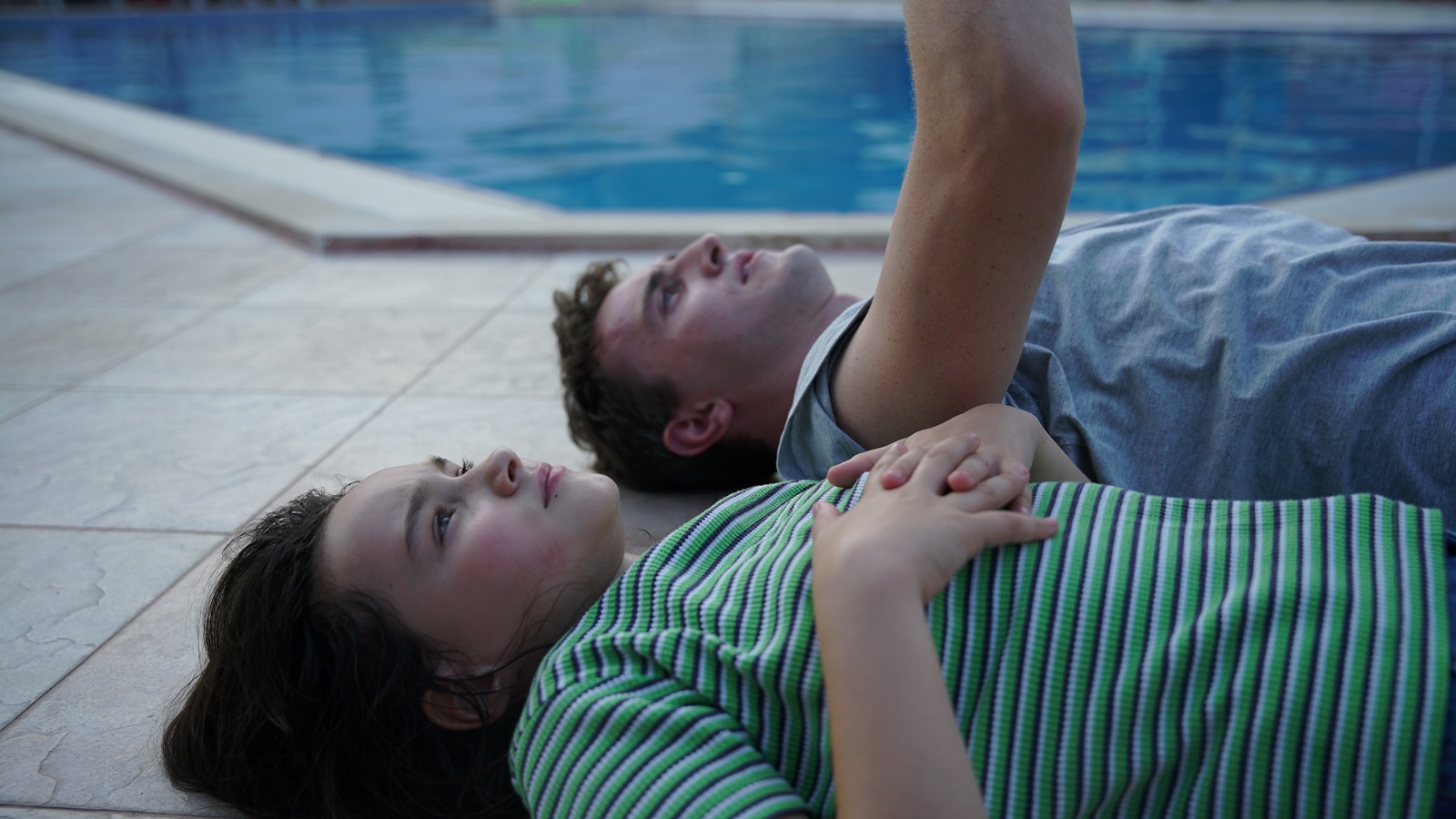
Taking a holiday with her father, Calum (Paul Mescal) in Turkey, Sophie (Frankie Corio) seeks to enjoy this individualized time. As certain elements of the vacation do not go to plan, Sophie begins to see how others around her have a more lavish vacation as she still tries to appreciate what her father has to offer.
It’s always great when new directors enter the scene and make a splash and while Aftersun did not make waves in the box office, it certainly did amongst film lovers. Watching the film, one could see why given the way it tells a story that delves into something so equally beautiful and achingly sad, it will surely gain some traction. Usually a film with these adjectives gets a higher rating on my end and receive much more effusive praise but there’s something distinct about this film that makes it fall a bit short. Specifically, it stems from how the narrative progresses that leaves the door open for others to connect with on their own. Ultimately, because the narrative itself did not grab me emotionally, it therefore left me a bit cold even if I can appreciate the original intent.
For the most part, the plot moves from scene to scene where singular moments occur for Sophie as she observes everything around her. This happens not only with what she sees with the surrounding fellow tourists but also with her father. More importantly, on a thematic level, it more so becomes what she does not see about the struggles her father contends with and tries to shield her from. These scenes string together quite loosely and it does not have the impact one would want when operating with something that carries so much meaning, which we can appreciate when looking at what Paul Mescal does as Calum.
Giving a more understated performance, Mescal does a splendid job in portraying this father trying so hard to put up this front and trying to not let these cracks show. From the famous dance sequence that punctuates everything in this story to the little glances he makes towards his daughter, it pulls at something so deeply sad. While the majority of this film focuses on the journey of Sophie as she experiences this vacation, Mescal fulfills his side of the bargain. Scenes with him worked for the most part but when the film spends too much time with Sophie with other kids where it just does not carry the same power, the film somewhat loses its luster. Inherently, that’s the risk when focusing so much of a film on one child only made worse when the adult character and the better actor had the more intriguing elements to the story.
Ultimately, this delineation defines why I cannot fully get my arms around this film where it has such great elements working in its favor and it simply refuses to play into them more. Wells certainly had a vision with this narrative, but I found the path she took in telling it to be lesser than what it could have been. Feels a bit harsh to say, especially given how much the reputation of this film has elevated it to a must-watch status, where the end result does not necessarily meet up to the expectations set for it.
All in all, a mixed bag for me, but still having many elements I can appreciate, Aftersun just does not fully click with me. The overall vision by Charlotte Wells outlines something that should emotionally devastate but just did nothing for me in that sphere. Instead, I just found enjoyment in Paul Mescal’s performance, as the guy continues to prove he can do no wrong in his performances even when his surrounding material does not match him.

 Films with Josh
