
Written by: Vladimir Bogomolov, Andrei Konchalovsky, Mikhail Papava
Starring: Nikolai Burlyayev, Valentin Zubkov, Evgeny Zharikov, Stepan Krylov, Nikolai Grinko
Rating: [4/5]
The horrors of war are well-documented in the way grown men have experienced the terror involved in it. Seeing it through their eyes have served as the foundation of many famous films throughout the history of cinema. However, looking at it through the eyes of a child makes that same ordeal all the more terrifying, with the combination of innocence and a deprivation of a future that will forever be hindered. Ivan’s Childhood displays this horror not through putting the child through horrific circumstances but rather focusing on how he processes it all.
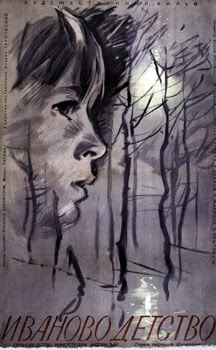
12-year-old Ivan Bondarev (Nikolai Burlyayev) awakens from a dream and sees a war-torn area and gets brought before Russian soldiers. As he ingratiates himself with the soldiers, he finds some use for himself in the midst of this conflict.
Utilizing children as the vehicle to capture the horrors of war treads dangerous ground because of their innocence and a general dislike of audience members to seeing them struggle in this. Putting them in war-like settings pretty much guarantees it but Andrei Tarkovsky navigates this dilemma in ways that does not wholly eliminate discomfort but still manages to deliver something quite terrifying as well. Certainly does not go in the direction of Come and See and its horrifying portrayal but still potent in its own right.
Watching Ivan go through the dredges of war shows a kid who has wits about him and knows how to navigate for himself, as much as anyone would expect from a child. He has this insistence of fighting on the front lines and trying to prove himself but the surrounding adults have different plans. He maintains this energy that spills not just from what he experiences in reality but also when we enter the several dream sequences he has. Each of them carry their own meaning and further illustrate what impacts this experience has on Ivan and what he has going on in his head. Whether fully understanding the implications of it or not, these dalliances into the mind of this child provides an insight only processing this through a dream sequence could communicate, which comes at no surprise given the director at the helm.
Like much of Trakovsky’s films, they visually stun in their composition, and the dream sequences become the perfect playground for him and cinematographer Vadim Yusov to flex their muscles. The stark black and white contains some beautiful contrasts that add a dynamism to the way we experience each of these sequences. Each of them continue to set this overall mood the film seeks to capture as we gain more insight into the mind of this child and the danger he continues to find himself in the middle of through no fault of his own.
As much as we experience this film through Ivan’s perspective, seeing how his presence gets a reaction from the other individuals in the story, especially the members of the military. Seeing how these individuals tasked with making decisions centered on ending the lives of others treat Ivan says plenty about them and displays where children stand in the world of war. Their innocence means absolutely nothing, where instead they represent another body that can go out there and try to serve and die for the cause. Not a second thought gets put to this and seeing how these army commanders navigate this circumstance feels like a much more damning condemnation than anything else within this feature.
Of the many things Ivan’s Childhood brings to the forefront through its story, the focus of the struggle between the Soviets and the Third Reich during World War II. Much of the stories told about this war that makes it to the United States places the focus either on the American and British forces against the Nazis, but also the plight of the Jewish people. The Soviets battling it out with the German forces does not get near the spotlight for reasons we can all quickly assume given the relations of the West with this nation shortly after the war. It makes sense we receive this given the director crafting this film, which adds something distinct about this film and how this struggle gets distilled specifically through this lens.
A truly devastating work and one that does not lay its hand firmly but delivers its narrative in a distinctly powerful manner, Andrei Tarkovsky does it again with Ivan’s Childhood. A wondrous film that utilizes gorgeous visual and lyrical scenes in dreams to communicate so much as it tells the story of a young boy caught in an awful situation. Revenge and duty both play a part in this story to see how what can drive a young boy to get involved in something he had no say in but ultimately found himself as a victim within it.

 Films with Josh