
.jpg)
Written by: Steven Knight
Starring: Angelina Jolie, Pierfrancesco Favino, Alba Rohrwacher, Haluk Bilginer, Kodi Smit-McPhee
Rating: [4.5/5]
When possessing a level of talent that draws envy, one can be forgiven when an air of invincibility builds around them that makes the inevitable decline all the more difficult. We often see this play out right before us with modern celebrities, but the manner in which Maria seeks to present this particular journey for the famous opera singer in this visually rich and hallucinogenic aesthetic makes for something incredibly memorable. In the third film of Pablo Larraín’s famous women of the 20th century, he hits every right note once again.
After a long hiatus, famous opera singer Maria Callas (Angelina Jolie) insists she can still perform at a high level despite not being in the greatest health. This leads her to rehearse with a conductor to ensure she gets herself in prime position to perform again while a television crew meets with her to document her life. The only issue with the crew is that they’re but a hallucination derived from the Mandrax medication she takes.
Having a character speak to the physical manifestation of a sedative-hypnotic medication displays Pablo Larraín really going into his bag in the way he sought to tell the story of Maria Callas. As mentioned previously, Larraín has now created this third film in his trilogy of defining women of the 20th century. He previously highlighted Jackie Kennedy and Diana Spencer, two immediately recognizable women because of their connection to the establishments they married into. Their specific films follow the women through a particular stressful period of their lives, yet they leave them in a place with a semblance of hope before them. When looking at Maria, it operates on a completely different wavelength.
Focusing on Maria Callas presents a completely different viewing experience given she does not nearly have the same recognition by the average person, and while this film focused on a particular moment in her life, the segment selected was her final days. Coming into this film, I had no clue who Maria Callas was, and after the final credit rolled, I cannot say I came away knowing much about her, but if that’s the goal, Wikipedia is only a few clicks away. Instead, Larraín opted to delve deeply into the mind of this leading lady as her fears, regrets, and insecurities lay bare before us as she talks to hallucinations.
We have the opportunity to learn about this woman not through a recounting of what has made her great but rather what matters to her when outside of her prime and how she looks back on her life as a whole. Learning how she wowed individuals at a particular performance gives factual information, but understanding how it impacted the interpersonal relationships she held with others throughout her lifetime allows for something far more enriching. Therefore, it makes it all the sadder that while she sits in her final stages of life, the only individuals left around her are two individuals she pays: her butler Ferruccio (Pierfrancesco Favino) and her housekeeper, Bruna (Alba Rohrwacher). Quite the approach to take, and it worked so incredibly well.
These interview sequences peel the onion back for her as Mandrax (Kodi Smit-McPhee) aims to dig deep and ask some piercing questions to get at what lies beneath the surface for this woman. It makes sense given the very entity asking her these questions literally has embedded itself in her bloodstream and brain. This demonstrates a level of self-reflection that becomes quite literal and while running the risk of becoming a bit navel-gazing, Larraín threads the needle so well in ensuring everything maintains a purpose in painting the portrait of Maria Callas.
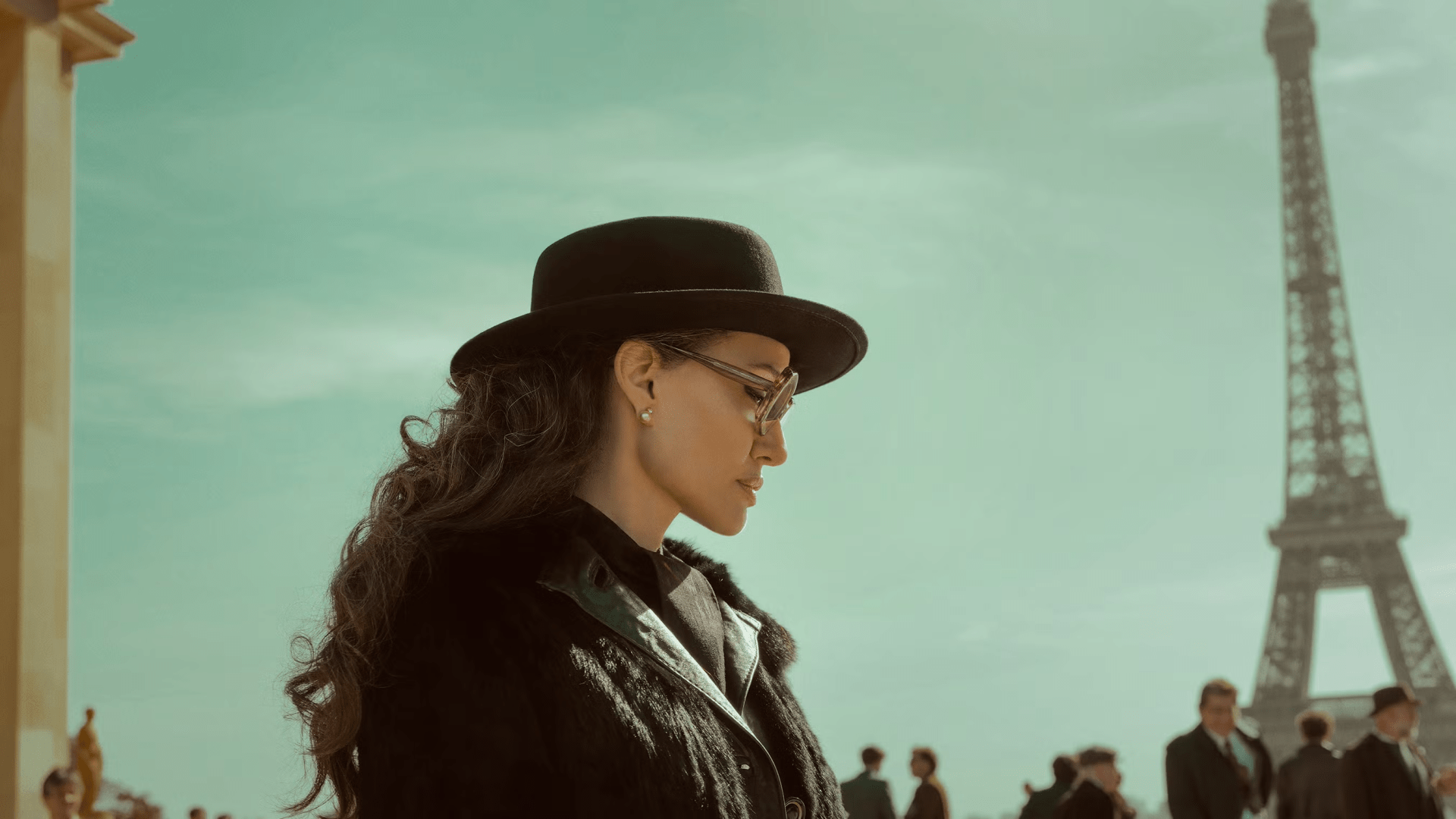
It certainly makes it all the more enjoyable to take in with Edward Lachman’s scintillating cinematography. Every single scene of this film visually astounds in how it presents a focus on Maria while also illustrating the lushness of the environment around her. She shines a light in every room she steps into even in her final days. Paris has never looked so dream-like and aspirational as it does in this film as Maria walks the streets and across many of the landmarks. No single scene looks flat even in the slightest because of Lachman’s work with lighting, only further adding to the greatness the narrative offers as well.
For far too long, Angelina Jolie has veered away from taking on a role that will challenge her in the way portraying Maria Callas would. Whatever her reasons, as she steps into this role, she delivers something that reminds audiences of her impeccable talent as an actor. Truly a captivating icon, Jolie embodies Callas in a manner that makes it very convincing how she has lived such a life and why so many individuals have gravitated towards her over the years. Jolie takes on the vulnerability of her character and how in her final days she wishes to just perform one last time as she did in the past, allowing this emotional catharsis and waiting for a release the film later provides. I have to admit, I had taken Jolie for granted for her prowess as an actor and she did everything in this role to vehemently remind me of what she can bring to a film.
Maria caps off the third film for Pablo Larraín and his attempts to highlight these incredible women. Through this film, he displays such an intoxicatingly beautiful environment for Angelina Jolie to navigate as this character internally goes through many moments of self-reflection. He helps bring Jolie back onto the screens in a role that allows her to stretch her wings once again. Everything this film did kept me on its wavelength, leaving me entranced by the imagery, the emotion, and the singing of the titular character. Such a gratifying experience, and if Larraín stops here in films highlighting incredible 20th-century women, then he capped it off magnificently.


.jpg)