

Written by: JT Mollner
Starring: Willa Fitzgerald, Kyle Gallner, Barbara Hershey, Ed Begley Jr.
Rating: [3.5/5]
While films with a genre try to differentiate themselves through what they provide within a story, they each follow familiar formulas. Horror films centering on serial killers focus on what the real world has shown us where it’s mostly men who like the idea of killing women for various reasons. It thus makes sense why this particular genre would follow that structure. However, with Strange Darling, this structure gets a bit shaken up as it delivers an intriguing manner to operate a film centered on a serial killer.
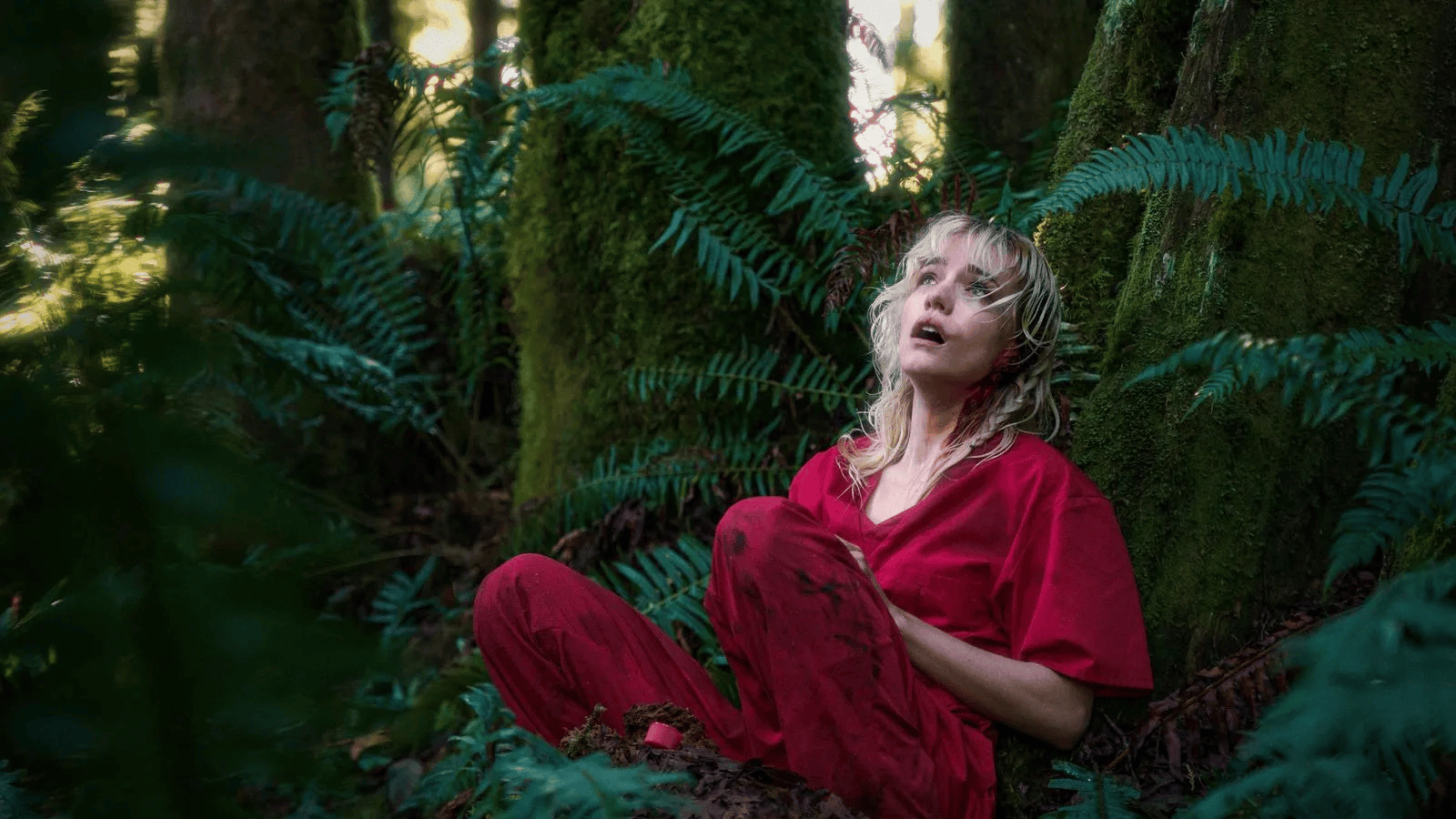
Running away from the Demon (Kyle Gallner), Lady (Willa Fitzgerald) gets her tire immobilized and she flees to a nearby house where an she pleads for the elderly couple to let her in. As the Demon gets closer, the Lady fears for her life as more of the story reveals more of what has led to this current situation.
Told in six parts and an epilogue, Strange Darling operates as a film solely attempting to subvert audience expectations. It starts out with what usually takes place during the final act of a film within this genre and then jumps around different points in the timeline to add some very important context. This additional context does not only fill in the blanks as to why we’ve reached this particular moment in the story but also serves to completely change the way viewers understand all of the characters involved. By that fact, this film lives on this big twist that may be easy to decipher through this review even with my attempts to remain cryptic. It relies heavily on pulling this off to work as a whole, and they certainly pulled it off.
As we take in these different segments, they never go in any particular order, as made obvious by each title card carrying an identifying number. It jumps from scene three to five and then one. All of this serves to release information to the audience in a manner that slowly but surely allows for the final reveals to display the true intention and story of this entire production. It does provoke thought of other films that could be told in this manner and work in the same way. This film, in particular, approached this method with a purpose.
Moving from scene to scene, Strange Darling seeks to highlight the realities of the gender dynamics on display and how they shape the initial perceptions audience members take with them in assuming which way this film will go. After all, it makes sense why we hold these assumptions given what the real world has wrought on who inflicts violence. The film makes it explicitly clear in a conversation between the lady and the demon outside of a motel room where she acknowledges the risks she takes whenever she has a rendezvous with a man. Women live with this fear constantly, but it all perfectly sets up where this film wants to go next through its narrative.
To sell the way the story flows, you need committed performances by the leading actors, and we received a pretty good portrayal by Kyle Gallner but a tremendous one by Willa Fitzgerald. She must fit into the particular role of final girl who escapes from the Demon mercilessly tracking her down. She embodies the fear this situation imposes upon her, but the narrative adds in the additional context and reframes much of what this character has presented in the first couple of segments. She’s devilishly good in each aspect of this as things become more complicated and the way audiences feel about her will inevitably shift. Such a fun performance by her and she really makes a big splash for the first time in her career, which has only further led to her getting more work.
Everything’s not as it seems in Strange Darling, an intentional choice with the way the six segments and the epilogue get presented in a different order. It allows what would work as a straightforward story to create a bit more of a surprise and a different experience as the twists and turns come not from something created in a linear process but simply from rearranging the scenes. A fun experiment that certainly works in delivering the intended entertainment this story offers along with its neon-drenched cinematography.


