
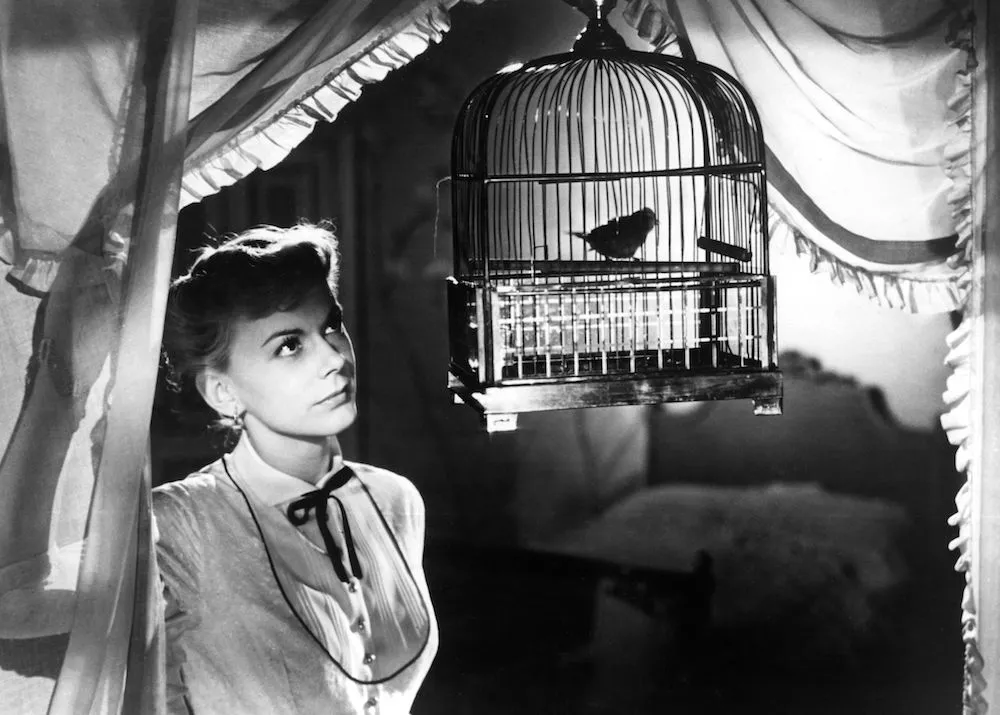

Written by: Alf Sjöberg
Starring: Anita Björk, Ulf Palme, Märta Dorff, Lissi Alandh, Anders Henrikson
Rating: [3/5]
For much of history, women have held fairly minimal rights and autonomy to make decisions outside of the whims of their father or some other patriarch running the show. Even when in spaces where they hold the upper hand socially, they can still sit at a disadvantage that Miss Julie points a finger at. It all leads into something quite entertaining throughout, even if it feels like the story goes all over the place.
With Midsummer’s Eve upon them, Miss Julie (Anita Björk), the daughter of the Count, opts to spend time with her servants. In particular, she spends time with Jean (Ulf Palme), a male servant, whom she has an attraction for. As she asks him probing questions about himself, their mutual attraction continues to build, leading to some uncomfortable conversations on the horizon.
Adapted from a play, Miss Julie presents quite the conundrum for its lead character but also shines a light in an interesting manner on a particular dynamic where we have an aristocratic woman with a servant man. During this era in Sweden and pretty much everywhere else in the world, women had zero to little autonomy on what they could do on their own in life. They’re lucky they can opt to walk across their own estate without permission from the highest-ranking man in their life. It sets up an intriguing parallel of the difference between the ruling and the working classes.
Within this class structure, there’s a balance of power that exists where Miss Julie can command Jean to sit with her, and he at the very least has the obligation to follow if not for the fact that he’s attracted to her and would not mind being around her. However, removing their class would quickly flip the power balance between them, which makes the discussion of them potentially running away together quite interesting. For Miss Julie, living outside of her father’s estate and not married to a man of social standing would automatically relegate her from someone above Jean in power to firmly beneath him. This larger societal implication informs the decisions they have before them.
While the pair have an attraction for each other, the most engaging element of this film lies in the way they continually attempt to psychologically manipulate one another based on how the dynamic shifts. As mentioned before, Miss Julie has the power at the beginning because of her father, but as they come closer and more intimate, her desire for Jean leaves him in a place where he can play with her emotions, knowing very well the attraction does not equate to love. In fact, Miss Julie is not even the only woman Jean has the affection of, where at the beginning of the story, it’s made clear he’s already romantically involved with the cook, Kristin (Märta Dorff). Therefore, he continues to have this ace in the hand that he has as a backup as well.
As the plot progresses and more revelations make themselves known, this story does get a bit darker in its themes and the actions of its character. While this game of flirtation between Miss Julie and Jean rages on, we learn more about the former’s family life, specifically her mother, and how her lack of presence very specifically plays a major role in her behavior. This continues on all the way to the conclusion, where the film really wants to end with an exclamation point that really makes an impression. Not sure it’s one I particularly cared for, but an impression it surely made.
Quite a tidy film, Miss Julie has very interesting pieces working in its favor. Alf Sjöberg wrote and directed the feature quite well in setting the scene and the stakes involved. You could draw similarities to Ingmar Bergman in the comedy and drama intertwined in an entertaining manner in addition to the Swedish connection. Anita Björk and Ulf Palme do well in their portrayals of their characters as they go head to the head, which makes for the main driving factor of this film. While the plot begins to go haywire in the third act all leading up to its fairly harrowing conclusion, it never failed to entertain and keep me locked in on everything happening at this particular estate.


