

Written by: James Gray
Starring: Anne Hathaway, Jeremy Strong, Banks Repeta, Jaylin Webb, Anthony Hopkins
Rating: [3.5/5]
Much can and will continue to be made about the racial divide in the United States as it continues to persist in overt and subliminal ways. It plays a part in the lives of many on a daily basis, and getting varying perspectives of it allows for an intriguing entry point. Through this personal story, James Gray gives his own perspective and experience of white privilege through the eyes of a Jewish American family. While the film decidedly lays out its ideas without a lick of subtlety, it certainly hits the mark on its stated goal.
In 1980s New York, Paul (Banks Repeta) attends public school and befriends a classmate named Johnny (Jaylin Webb). The two hit it off, but after getting caught smoking a joint in a school bathroom, Paul’s parents opt to send him to a private school, therefore showing the divide in the life he gets to live compared to Johnny.
Entire dissertations and courses can speak about the way race and discrimination permeate into all facets of life. It makes sense why the going definition does not center on just the individuals but rather an entire system. The ridiculousness of racism continually proves itself as the very definition of what makes a white person white has changed all throughout history. In the early 20th century, Italian, Polish, and Jewish people would not have been considered white, but by the time the 80s come around, they have all been pulled into the umbrella. Jewish-Americans and their whiteness take center stage in this film as Paul learns some inconvenient lessons about the privilege he holds compared to his African-American friend.
Having a story like this one centered on a Jewish child brings a special intrigue given the current ever-present discussions about rampant antisemitism. However, the main focus in this film remains on race, and the intention of James Gray becomes crystal clear as the film progresses. He wants to display the inequality at hand in the lives of the two boys with Paul as the vessel to teach this lesson. By vessel, I mean the adults in his life literally teach him lessons about the way to be a good ally and not stand by when he witnesses racism towards another. Some of this can be seen as too on-the-nose, but I cannot fault it for having such a heart, especially in the way all of this gets communicated.
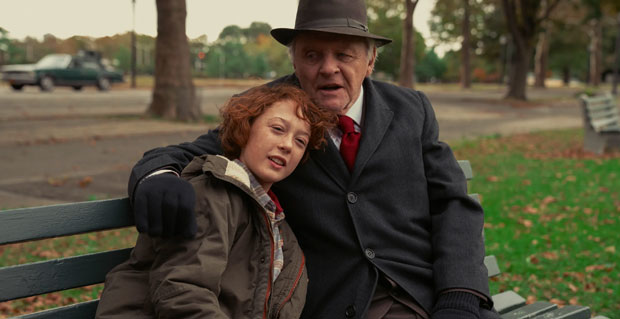
The main emotional throughline occurs with the relationship Paul has with his grandfather Aaron (Anthony Hopkins), who tells his grandson the tales of how the family came to America fleeing from antisemitism. It’s the relationship between these two where the biggest lessons occur but done in a way that allows Anthony Hopkins to thrive in his role. Aaron’s parallels for the hardships they faced in Europe compared to what he has seen in America serve as quite the shot across the bow. He makes the case why Jewish people have a duty to protect other underprivileged individuals because of what they have experienced as a people. This then seeps into the conversations held with his parents and the ways in which they see the world and the benefits that come with their skin color.
It helps to forgive some of this film’s execution because of its presentation, especially as the third act arrives and delivers the haymaker Gray has continually wound up and then let rip. A climax that let me appreciate exactly what the director seeks to communicate with a harshness that burns mostly because of its truth. A reminder of something we know very well but like to ignore when looking at certain statistics and how it impacts the lives of individuals, both young and old. This third act completely elevated this film, which I sat fairly lukewarm on throughout, but it catapulted it much higher in my estimation.
Not a single ounce of subtlety in a flawed but admirable manner, Armageddon Time paints a portrait of America that many know and have seen in other films. Allowing for this perspective to come from the Jewish-American community adds a different view that more than justifies the viewpoint this film brings. Whiteness as a construct has allowed many to receive its protection, but Paul’s family members seek to teach him how to wield it and use it for the security it provides them and not others through no fault of their own.


