

Directed by: Teinosuke Kinugasa
Written by: Teinosuke Kinugasa
Starring: Kazuo Hasegawa, Machiko Kyō, Isao Yamagata, Yatarō Kurokawa, Kōtarō Bandō
Rating: [3/5]
It’s not breaking news to point out there’s a much longer time in the breadth of history where women have not had basic rights compared to what they have now. It left them with little power when a man sought to impress himself upon them, which presents an unsettling position for the woman in Gate of Hell. When a simple no does not suffice, more drastic measures need consideration.
Serving her leader by standing in for a noblewoman, Lady Kesa (Machiko Kyō) is escorted to safety by the samurai assigned to protect her, Endo Morito (Kazuo Hasegawa). After the completion of their mission, Morito becomes smitten by Lady Kesa and wishes to gain her affection. Unfortunately, he learns she’s married, but that will not stop him from claiming the woman he wants.
One of the more disconcerting behaviors by “good guys” is the idea that because they treat women respectfully, women somehow owe them their bodies. A completely toxic approach that defies the very descriptor they place upon themselves. In a way, Gate of Hell depicts this to the extreme, where Morito did well to save Lady Kesa’s life when she was used as a literal decoy. However, when she rebuffs his advances with the valid claim of her being married, Morito’s insistence for her to throw away everything for him at best is delusional and at worst becomes incredibly coercive. Therefore, we have a film of Lady Kesa continually trying to keep away from the clutches of Morito, including trying to enlist the help of her husband.
Setting up the initial interaction between the two lead characters is the rebellion going on, where Taira no Kiyomori (Koreya Senda) tries to fend off a group of rebels from taking over the area. As the feudal lord of the area, his gratefulness towards Morito and the great work he did in quelling this rebellion leaves him in an awkward place where he seeks to grant the wish of the men for helping him remain in power, but he can only go so far. Allowing a man to have the wife of another married man is too much of a demand, but his position begins to change. This begrudging permissiveness opens the door for when things begin to heat up and Morito ups the ante in his pursuit of a woman who continually rebuffs him.
With the drama this story navigates, it does a great job at capturing the helplessness of Morito throughout this story. Machiko Kyō certainly aids in this effort, as she has no real power here. She can continually say no to this man, but evidently something about her makes her completely irresistible. Her only hope lies in the other men around her to stop anything else from progressing, including the feudal lord Kiyomori and her husband, who hold him back through threats of authority and violence, respectively. It only gets worse when Kiyomori begins to sympathize with Morito and somewhat gives him a green light to try and impress, which leaves Lady Kesa in a desperate spot to end this.
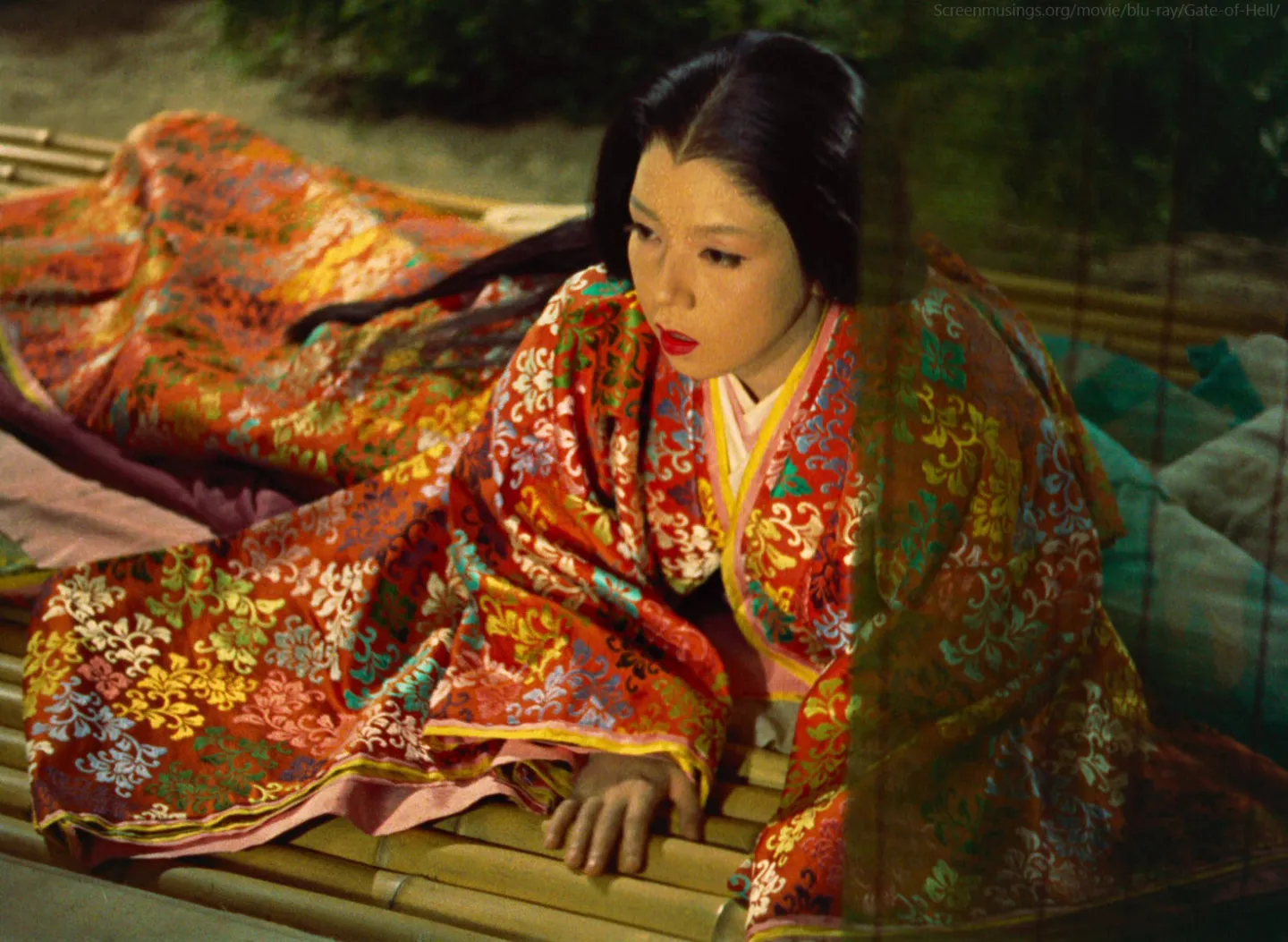
When watching the film, one of the elements that will undoubtedly stand out is the use of color. Everything happening here looks incredibly rich and saturated with its deep colors. It does feel similar to Kurosawa’s Ran in the way it so vividly creates these wonderful compositions that allow this film to pop. Especially considering this film was made in 1953, it dazzles in the way Kōhei Sugiyama captures the beauty of the costumes and the set locations within this film. It’s a truly visual treat that only aids the rest of the narrative.
While having a simply unfortunate tale at its core, Gate of Hell provides plenty of insights into how things operated during this period of time in Japan. Women did not have much of a choice in quelling the desires men had for them. Lady Kesa experiences that firsthand, where one could only shudder to think how everything would have progressed had she not had the status of lady-in-waiting. The final act and conclusion only further punctuate the disheartening reality of Lady Kesa and all women of this period, with it all culminating into something very watchable even with the discomfort it evokes.


